Bio
Short bio (about 50 words)
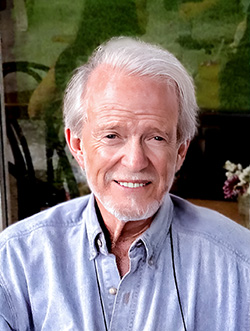
Rogers Follansbee, PhD, is a research psychologist and the creator of Structured Psychology, a theory of human behavior he first defended as his doctoral dissertation at the Universidad de Navarra in 1974. He is the author of It's Not Your Fault; It's the Structure. He divides his time between northern Spain and southern California.
Long bio (about 230 words)
Rogers Follansbee, PhD, grew up near Chicago and on the East Coast. As a teenager he set out on what he expected to be a few weeks of travel abroad, stopped in Madrid for a couple of days, and made Spain his home. He studied philosophy at the Universidad de Navarra in Pamplona, earned a master's degree in clinical psychology from the Universidad de Madrid in 1971, and taught "The History of Psychology" and "Psycho Diagnostics" to Navarra undergraduates from 1969 to 1974.
His doctoral research began as a study of Anna Freud's defense mechanisms. Two years into it, he concluded that projection and its relatives were the downstream effects of something more basic. In 1974 he defended the result, "La Teoría de la Relacionabilidad" (the Theory of Relationability), and received a Summa Cum Laude qualification.
He moved to the United States with his family in 1980 and kept refining the theory, now called Structured Psychology. Its central claim is that human behavior follows a logical structure built on three requirements every living thing shares: relational activity, confirmation, and continuance. Researchers have spent the decades since 1974 moving toward relational models of the mind, and Rogers's dissertation is a datable early statement of that idea.
It's Not Your Fault; It's the Structure, written with Leah Donell, is the second edition of his book for general readers. Rogers and his wife, Carmen, divide their time between northern Spain and southern California.
The book
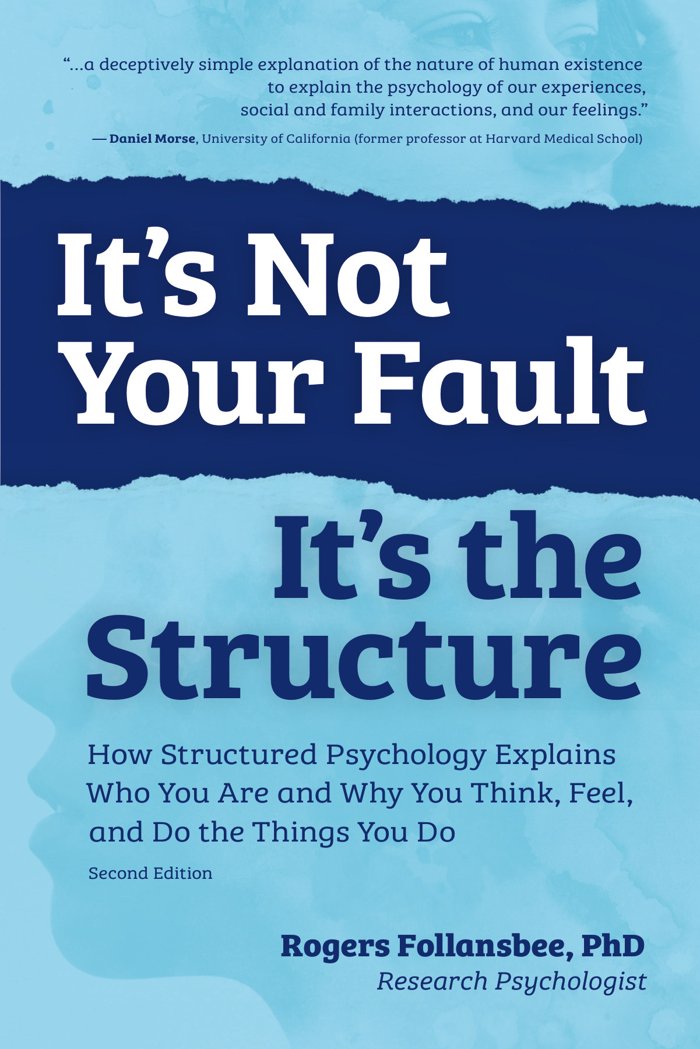
It's Not Your Fault; It's the Structure
How Structured Psychology Explains Who You Are and Why You Think, Feel, and Do the Things You Do
Second Edition · Rogers Follansbee, PhD
Rogers Follansbee argues that human behavior is a logical system to be understood rather than a disorder to be diagnosed. He calls the system the Structure: a set of relational rules that holds for every person in every relationship. In nine chapters he shows readers why contradictions knock us off balance, what we do to restore that balance, and why our self-image is only partly under our control. The final chapter turns to what a reader can do with that understanding.
| Paperback | ISBN 979-8-9905806-5-7 · $19.99 |
|---|---|
| Pages | 250 |
| Edition | Second Edition, 2026 |
| Publisher | Axes Avery Publishing |
| Co-writer and editor | Leah Donell |
| Website | StructuredPsychology.com |
| Buy link | learn.structuredpsychology.com |
"…a deceptively simple explanation of the nature of human existence to explain the psychology of our experiences, social and family interactions, and our feelings."
Daniel Morse, University of California (former professor at Harvard Medical School)
Contents
- Preface: Butterflies and Bureaucracy
- Introduction: A New Way of Thinking
- Where the Structure Comes From and How Far It Goes
- Our Relationships Show Us Who We Are
- Our Relationally Relevant World
- The Different Shapes of Contradictions
- Damage Control
- On the Defensive
- Who Am I?
- The Structure Within Our Society
- Remember Where Your Power Lies
A note for hosts
Rogers is at his best when you ask him why. He answers every question from inside Structured Psychology, so a conversation about texting, grief, politics, or a fear of flying will come back to the same three requirements: relational activity, confirmation, and continuance. Hosts who build the episode around that framework get a focused, surprising conversation. He is less suited to a show that wants a list of tips or a guest who will adopt the host's own model.
Interview topics
Each topic is a full episode on its own.
- Why we do the things we swore we wouldn't. Self-sabotage, broken resolutions, and the logic behind behavior that looks irrational.
- What projection is. Rogers spent two years of his doctorate trying to understand projection and came out with a new theory. He explains what he thinks it is and why it matters in every argument.
- "It's not your fault" without blaming anyone else. The title sounds like a pass on accountability. Rogers explains how limited our control is over how we think and feel, and where our real room for choice is.
- Why friendships end and families fight. Confirmation and contradiction at the dinner table, in group chats, and at work.
- Your surroundings shape your mood. Rooms, towns, and the people in them, and why moving house can feel like losing part of yourself.
- Why we're tribal. Politics, sports teams, and keeping up with the Joneses as the same relational need.
- Anxiety, fear, and the need to continue. Why anxiety makes sense once you know what it is protecting.
- A theory from 1974. How a young American in Spain came to question the defense mechanisms he was taught, and what he has tested since.
Suggested questions
- In one sentence, what is Structured Psychology?
- You set out to study Anna Freud's defense mechanisms. What did you find instead?
- What are the three requirements you say every living thing shares?
- Your title is It's Not Your Fault. Does that mean nobody is responsible for anything?
- Why does being told we're wrong feel so threatening?
- What is a "contradiction," in your terms, and what do we do when we meet one?
- Why do two people in the same room come away with completely different experiences?
- Can a person change? If not, what can they change?
- Why do we defend ourselves before anyone has attacked us?
- What does Structured Psychology say about loneliness, and about wanting to be alone?
- You've lived half your life in Spain. Does the Structure work the same way across cultures?
- What would you like a listener to notice about themselves tomorrow?
Talking points
In Rogers's own words, from past interviews.
- "You can't change who you are, but you can change what you understand about who you are." The Chris Voss Show, 2025
- On the title: the book is not about blaming others. It is about how limited our control is over the way we think, feel, and behave. Paraphrase, The Chris Voss Show
- "Nothing can exist without that thing being in relationship with something else." Change Made Easy, 2025
- On choice: "You have choices. You have to weigh them according to your ability and your experience." The Chris Voss Show
- On his doctorate: he expected to explain projection and instead found that what psychology students were taught about projection "wasn't Projection at all." Authority Magazine, 2025
Past appearances
| Date | Show | Host |
|---|---|---|
| Apr 27, 2025 | Authority Magazine (written Q&A) | Yitzi Weiner |
| May 26, 2025 | The Chris Voss Show, ep. 2276 | Chris Voss |
| Jun 20, 2025 | Famous Interviews | Joe Dimino |
| Jun 24, 2025 | Change Made Easy | Paul Levitan |
| Nov 4, 2025 | Inner Voice: Heartfelt Chat with Dr. Foojan | Dr. Foojan Zeine |
| Nov 5, 2025 | Happiness Journey with Dr. Dan, S31 E8 | Dr. Dan |
Rogers also posts short explainers on YouTube at @structured_psychology.
Book Rogers
To book Rogers for a podcast, an interview, or a written Q&A, contact Veronica Mathai.
media@structuredpsychology.comRogers is available for interviews in English and Spanish, by video or audio. He does not travel, so every appearance is virtual.